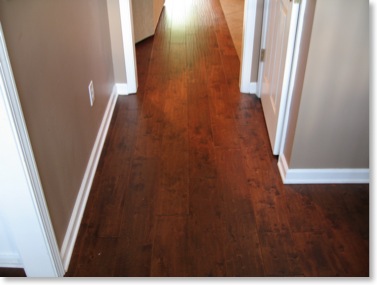
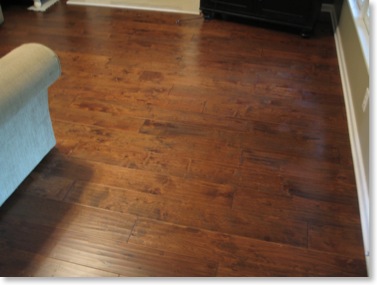
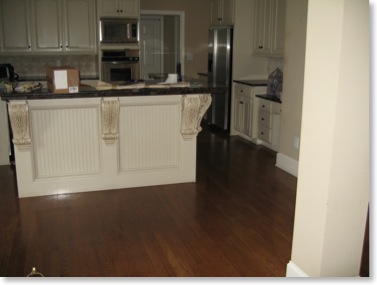
Solid Hardwood Floors
Solid hardwood floors as the name says are solid piece of wood cut from a wood log into a solid plank and the tongue and grooves are milled on all four sides. They range from 5/16" to 3/4" in thickness and come in various widths and generally are in random lengths. Solid wood planks are sold in both unfinished bundles or prefinished at the factory and sold in full cartons. You can buy solid wood flooring in a variety of North American wood species as well as exotic hardwoods from different countries from around the World.
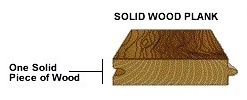
One of the benefits of a solid wood floor is they can be refinished several times, which adds to their appeal and to their long life. There are many old solid wood floors that are several centuries old and are still in good, useable condition today.
Unfinished solid wood floors come in several different qualities. These qualities are clear, select and better, #1 common, and #2 common.
* Clear has no visual blemishes or knots and is extremely expensive.
* Select and better has some small knots and very little dark graining
* #1 common & #2 common have more knots and more dark graining.
Engineered Wood Floors
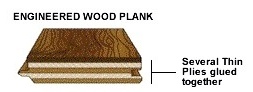
Engineered wood floors range from 1/4" to 9/16" in thickness, and from 2 1/4" to 8" in width with random lengths. The top finish layer is cut from a variety of North American hardwoods as well as many different types of exotic wood species. The top wood ply is also generally sliced cut, rotary cut, or sawn. Each gives a unique visual to the wood face.
Hardwood engineered floors are often confused with laminate floors because they are constructed of several wood plies that are laminated together. Laminate flooring is constructed differently and uses a photo print to simulate the appearance of real hardwood flooring. (Note: there are some laminate floors that have a thin ply of wood veneer as the top layer and use a fiber core underneath.)
These floors are the best choice for installing over concrete slabs and in basements. You should still check if excessive moisture and humidity are not present. (Note: concrete slabs must still be dry, clean and fully-cured.) This makes engineered wood floors ideal for many homes in southern or western United States.
Engineered gluedown floor